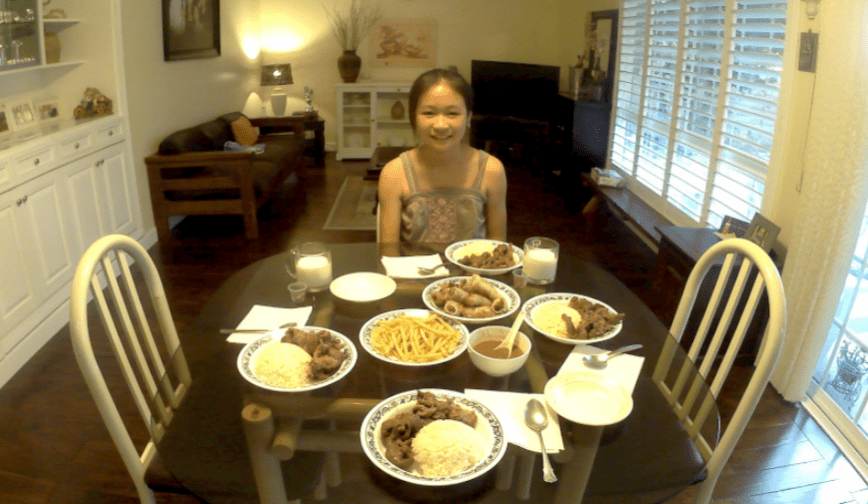
Surrounding the dinner table with exuberant family members, delicate foods, and positive energy is the happiest thing I could ask for.
As my Girl Scout sisters and I stand around our campground bench with our 7:00 am breakfast on our plates, we sing the traditional dinner time song and raise our plates.
My grandpa makes a speech to gratefully thank our family members for arriving at the gathering, hosting a weekly potluck, and appreciating the food we have on our tables.
Breakfast, lunch, and dinner and the moments of our days that we are granted the opportunity to gather with our families to appreciate every little thing we have. In Vietnamese school, I learned a saying, “uống nước nhớ nguồn,” meaning that every time we get a sip of water, we have to think back to where this water came from. It came from rainy waterfalls, streams, rivers, icebergs, glaciers, etc. Another important saying I learned was “ăn quả nhớ kẻ trồng cây,” meaning that whenever we eat fruits or produce, we must think back to where this produce came from. Farmers grew these produce on trees, spent much time and effort watering the plants, waited for them to ripen, and sold them into the markets we found them at.
“There are many in the world dying for a piece of bread, but there are more dying for a little love.” -Mother Teresa
I think that during this period of the COVID-19 pandemic, most of us have learned to be grateful of the food that our food bearers have worked to provide us with, especially with the limited trips due to the markets. I, myself, have learned that it is necessary that we all use this time wisely. Instead of having to make so many trips to the market to buy vegetables, we can buy a bunch of vegetables then plant it in a pot and preserve it for a lifetime use, as new ones grow out.
“Tada referees the accusation in Jeremiah that the people have forsaken God as Living Water by remembering a hiking trip from her younger days. Reaching a clear stream at the end of her trip, she emptied her canteen of the warm, metallic-tasting water and filled up on fresh water.” -Joni Eareckson Tada
I was young, maybe 8 or 9 around that time. My mom had sent us to the market and while sitting in our car, my father discussed how hard his long hour work days were. I remembered his exact words: “When you grow up, learn to be like me.” I laughed then he said, “I work 13 hour shifts to bring home the bread.” Because I was an immature child, I did not metaphorically know what this sentence meant. I foolishly replied, “I get sick of eating too much bread.” My father laughed. It was not until later, that I was mature enough to understand what this meant. He was the food bearer. My parents were hardworking and found that it was their first priority to raise my brother and me, and to sufficiently place enough food on our tables every evening. They often remind us, “You will learn to conserve your money until you get a job.” Although I am too young to have a job as of right now, and especially since many have been unemployed due to the pandemic, I understand that employed individuals value their money very much.
“You will never know the value of money until you worked hard for every cent.” -Russell C. Patalinghog
When we were younger, my brother and I, once in a while, wasted portions of our food. We rarely ever throw away our food anymore. Whenever I think about wasting food, I think about those who are dying of starvation, especially in the un-wealthier regions, such as Africa. According to the Voice of America, more than 21,000 people are dying each day, as a result of starvation and malnutrition. This dates us back to the Holocaust, further back into the Great Depression. In the Holocaust, Nazis mistreated the Jewish, forced them to work until they collapsed and fed them small portions of un-nutritious and horrendous foods that did not last them through 15-hour work days. During the Great Depression, when the economy was demolished, malnutrition became a leading cause of death among young and elderly Europeans, especially with the lower-class citizens. Unemployment was what caused malnutrition to become such a large crisis. People stayed at home with no wages and not enough to purchase food (bread) for their large families. Not only were these unfortunate European starving for food, they were also starving for money.
“I am the bread of life; he who comes to Me will not hunger, and he who believes in Me will never thirst.” -John 6:35
Because we’re free handed during this time, maybe we can all participate to take a few moments to appreciate that we have all made it here today. It has been a long way and a long way further ahead of us, but at least we have fought through every difficult moment of our lives. Take these moments to appreciate your family members, and thank them for all of their hard work and efforts to have you here with them today. Remember these days forever.
Front page feature image credit: Photo by BBH Singapore on Unsplash

 Quaranteen
What a wonderful read. Thank you.
LikeLike