Humans are born as irrational creatures. As humans mature, they learn to think rationally, and gain the ability to suppress their emotions in favor of using logic to fuel their decisions. However, in the face of extreme circumstances, humans will let go of their rational minds, and return back to the irrational minds they were born with. This internal conflict of logic or emotion is something all humans, past, present, and future face. Most of the time, the right approach is the rational approach, but when the world deals you an unfair, in some cases, immoral hand, is it okay to let go of your rationality?
A rational mind will forgive, but when is an injustice so unforgivable that approaching it rationally is, in itself, irrational? One of the greatest injustices of the past century in American history has been the Internment of Japanese Americans in World War II. Thousands of innocent Japanese Americans had their homes, jobs, possessions, families, etc. taken away from them, in the name of national security. They were then forcefully relocated into internment camps, where they would spend the next three years of their lives. All for something they were born with- all for something that was out of their control. In the aftermath of the camps, the US Congress gave a formal apology and passed the Civil Liberties Act, which granted them $20,000. For many Japanese Americans however, this was not enough for forgiveness.
George Takei’s graphic novel, They Called Us Enemy, details his and his family’s experience before, during, and after their internment. A scene on pages 180 through 182 depicts Takei’s father refusing to shake the hands of Mrs. Eleanor Roosevelt, wife of Franklin D. Roosevelt. This is contrasted with everyone else in the building, including George himself, choosing to do so. George’s father made his decision because he could not forgive her husband, who ordered the internment of his family and thousands of others.
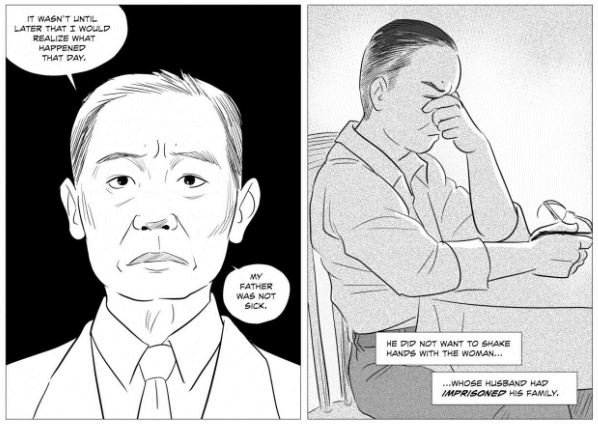
Compared to the rest of the people in the building, his father’s actions seem irrational. Remaining resentful will not solve anything. He maybe could’ve even found peace in talking, or even lashing out at her. He is avoiding confrontation, and choosing to remain resentful, but maybe it was best he did. All the pain he and his family went through was also due to an irrational decision. Why should George’s father be expected to act rationally, when the reason he is harboring his resentment is because of an irrational decision?
Some people can find a way to forgive even the worst injustices brought upon them, but many others won’t. Rational thinking will show that it is best to confront and forgive, rather than run away and live with resentment, but humans are not meant to always be rational. In some cases, maybe it’s best to throw away the rational mind, and simply be human first.

 Quaranteen