Although you may not see it, members of the AAPI community continue to face the ongoing battle of discrimination and racism in the United States. Many problems of the past are the same as today. During WWII, many Japanese Americans were thrown into concentration camps by the American government. The trigger for all of this was the bombing at Pearl Harbor, which caused the government to label all Americans of Japanese descent as “Alien Enemies”. In relation to today, a lot of Asians are being oppressed and hate-crimed for their race. We are taught history in school so that we don’t repeat past mistakes, but why is this still happening again?
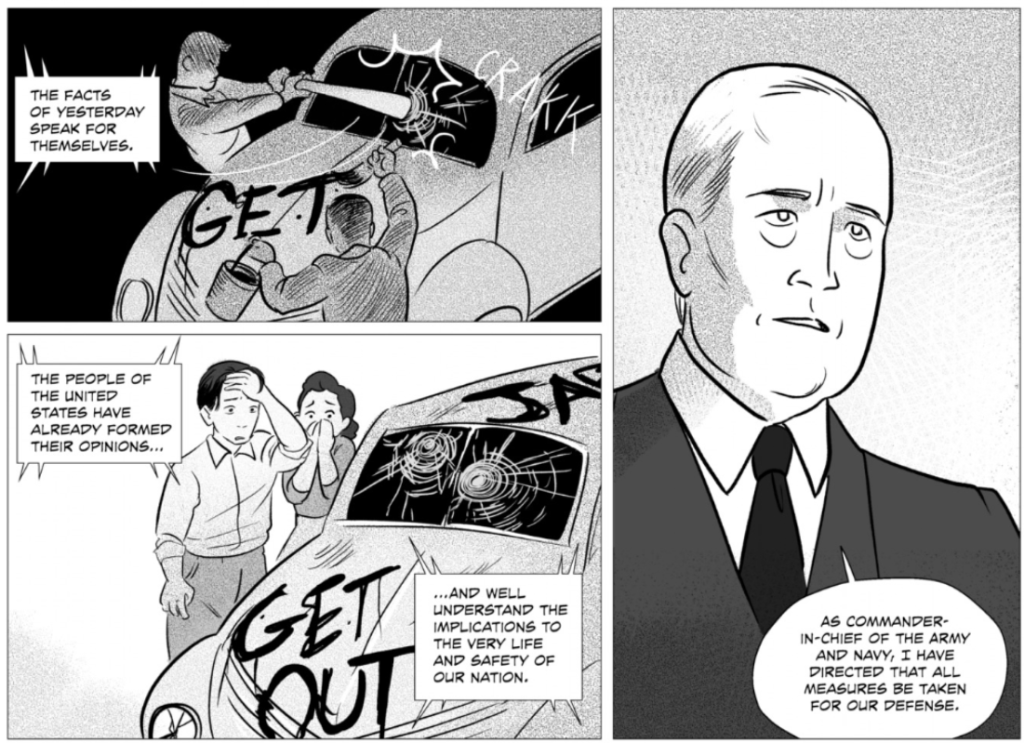
In the graphic novel They Called Us Enemy written by George Takei, George takes account of the hardships that not only he and his family but all Japanese Americans faced throughout the majority of their life. An example of one of these hardships is how Japanese Americans were constantly being judged and harassed by white Americans. The picture above takes place right after the bombing of Pearl Harbor, and a proclamation was sent out declaring that all adult Japanese citizens inside the U.S. were now “Alien Enemies”. Of course, most Americans were quick to judge, as they didn’t allow Japanese Americans to go into certain stores or refused service towards them. These were only a few of the many drastic consequences of the bombing. Soon after, they were forced to live in concentration camps for years where they experienced horrible living conditions. Even though other Americans were not forced to do so, Japanese families also had to make an impossible decision whether to conform or resist, in order to prove their patriotism for America.
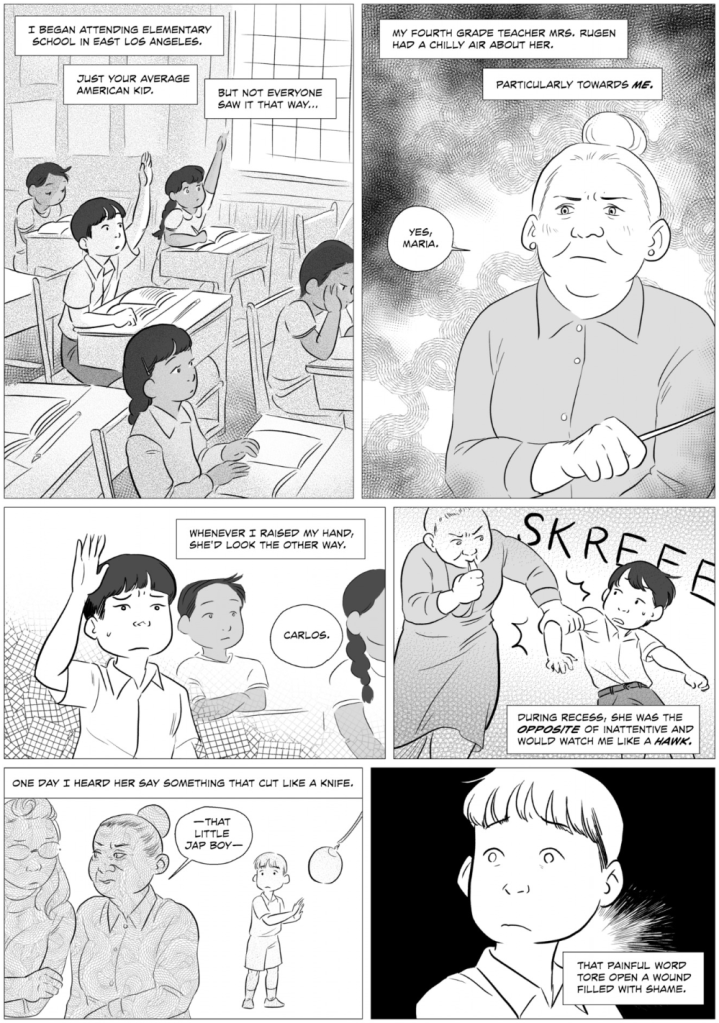
As I was reading this graphic novel, the page shown above brought up a time when someone very close to me experienced racism. I was strolling along the sidewalk at Huntington Beach with my mom, a friend of mine, and her mom. We were getting ready to walk to our car when I saw two white men who weren’t wearing their masks approaching my mom. This was during the peak of the pandemic when Asian hate crimes began becoming more apparent. My mom continued walking whiling trying to avoid these two men. However, as their eyes landed on my mom, they saw that she was an Asian woman wearing a mask. They came closer, pointed finger guns at her, and pulled their eyes back, which is a common stereotype towards Asians. As if this wasn’t bad enough, they began hurling slurs at her such as “Chinese Virus” and Kung Flu”, before laughing and walking away.
My mom was stunned in a state of obscenity; never in her 40 years of coming to America has she ever experienced something like this. First of all, referring to the coronavirus as these xenophobic terms is already offensive to Asians. What made this situation even more frustrating was how we weren’t even Chinese! To this day, I’m not sure if this made an impact on my mom’s life, but it definitely did on mine. I was disgusted by the way these two men treated my mom, but it was only a mere example of how there were many others like them, and that many Asians are going through even worse situations.

Throughout history, members of the AAPI community have faced a constant cycle of discrimination. On top of being a woman in America, I, as an Asian American myself, now have the added fear of getting hate-crimed for my race. I also fear that my friends and family could possibly be the next target of discrimination. Fortunately for me, I was able to grow up in an area where I’m not a minority, but elsewhere, I feel diminished. Past mistakes have taught us to treat others with more kindness and equality. We can learn to support and uplift each other rather than degrading another human. Some people have the privilege of learning about racism instead of experiencing it. Whilst living in an age of technology, we have all the available resources to educate and spread awareness on these matters. Learning from Asian Americans who experience these injustices firsthand can open up a new perspective of the world that we live in and help us recognize the truth and reality in today’s society. Don’t let our country’s past mistakes define your future.

 Quaranteen