Recently, I had just been assigned to read a graphic novel titled “They Called Us Enemy” that was written about George Takei. It focuses on his journey and life through the internment camps as a child during WW2. There are so many instances within the novel that caught my attention, disturbed my brain, made me wonder about something, etc. Now if I were to write about that whole thing, this post would be insanely long so I am going to try to keep it short and sweet.

A panel I saw that I both noticed and disturbed my thinking is the panel above. It comes from page 125. In this panel, the shading done to the tower and soldier enforces the evil that the Japanese-Americans feel within the internment camp. However, from an outside perspective, like a reader, that evilness is likely undersold and the reader doesn’t grasp how much there was. For those Japanese-Americans in the internment camps, they had to see that everyday in a place that was out of the norm for them. They were stripped away from what they know as home and transferred to a random place in the middle of nowhere. To add tall towers and soldiers with guns makes it seem like they are getting towered upon by a huge enemy. As a reader, I was in my room reading this and I was comfortable without any “evil” people looking down on me. So, it must have been absolutely terrifying for those within internment camps.
Now the more obvious observation was that this graphic novel could be applied to the treatment of Asian Americans right now. Japanese Americans in the United States weren’t responsible for the bombing of Pearl Harbor, but were still treated like trash simply because a part of them was Japanese and they looked different from everyone else. Today, we have the coronavirus that was brought from Asia and even though Asian Americans had no part with bringing it or causing it, they are getting abused and harassed simply because they are Asian. It has gotten to the point where if I were to go outside to another city a couple hours away, I know there is going to be fear in my body and the chance I get treated differently because I am Asian. That is a connection I made to real life.
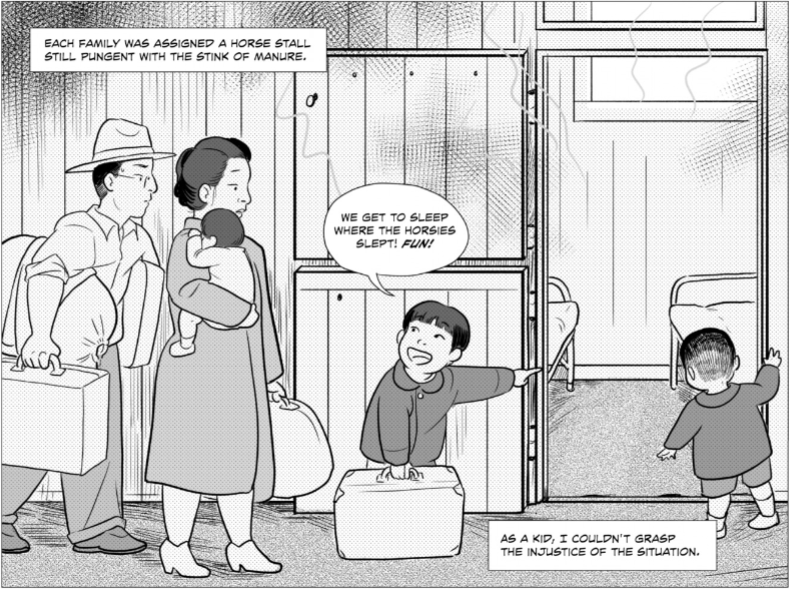
This next panel comes from page 32 and it shows the children’s innocence and purity. George’s family was assigned to live in a horse stall and the children found it fun and joyful, even tho the parents knew how bad this was for them and how much of a downgrade it was from home. I noticed how children the innocent were to not be able to grasp the gravity of the way they were being treated and it reminded of how when I was younger, I was really innocent and joyful about everything, even though it may have been a bad thing.
Seeing how both Japanese Americans then, and Asian Americans now are being treated horribly made me think that I should share this with others and get their eyes opened to how similar it was and how they can turn attention to Asian Americans today. The treatment of Japanese Americans then should have served as a lesson for those today, but it clearly hasn’t and is something every country and nation to strive to get better at.

 Quaranteen