Some could say that COVID-19 has stripped us of the past year and any type of normalcy we held onto. But it isn’t just the pandemic that constrains us in our own homes, it’s also the government that puts into the question of quarantine ethics. The higher authorities and government vouches for our natural rights. This has been put in conflict with the question of safety until the solution of vaccines seems plausible. The virus may not have fit into the extremes of the right and wrongs compared to World War I, but certainly parallels the choice of whether to remain subservient.
A graphic novel called They Called Us Enemy, is about a family’s experience in World War I and how they went through the internment camps. In the graphic novel, there have been many situations shown where the Japanese Americans shared a sense of emotions within one another, even though they were isolated from the Americans. Unlike the Japanese, we have distanced ourselves during the pandemic. While a small portion of the population have been impartial to the perpetual changes to society, social distancing and quarantine are analogous to the disconnection we have all experienced. Many in our society have looked through this pandemic through the lens of hate and have acted out hate crimes against African Americans and Asian Americans. It is not surprising that we have turned against one another and found more ways to isolate ourselves, rather than finding ways to understand each other and keeping our community safe. We can admire how the Japanese Americans value sticking together and supporting each other even in the most difficult of times.
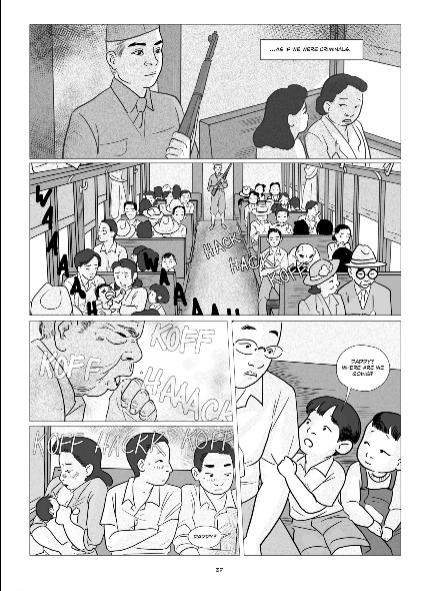
During World War I, authorities in higher positions believed that national security was more important than personal liberty. The Pearl Harbor bombing sparked an immense movement of distrust against Japanese Americans. The United States government wanted to eliminate all “threats” by sending innocent Japanese Americans to internment camps but, looking back, this act was completely immoral and wrong. The image shown to the right displays a scene from They Called Us Enemy and the top two panels demonstrates how differently the Japanese Americans were being treated. This train scene, where the Japanese were being transferred into internment camps, was one of the first actions made to respond to the national security “threat”. The government reacted quickly before letting Japanese Americans have a choice of either staying or leaving their homes. National security was prioritized over personal liberty and the Japanese Americans were stripped of their personal rights. It shows how the guards were watching over them at all times as if they were prisoners. Innocent Japanese Americans were grouped together with Japan’s actions and they were looked at as enemies.
As of the present, national security has also been prioritized over personal liberty. However, it is fully justifiable and done so to make a positive impact. Social distancing and mask rules have been implemented and many have complied. On the other hand, many people believe that this pandemic isn’t as dangerous as people make it out to be and, therefore, disobey the rules. If personal liberty was prioritized, there wouldn’t be any rules of social distancing and people would be granted the freedom they want. In hopes to ensure the safety of our community, national security has been prioritized for what I believe are the right reasons.
However, it is crucial to adapt and cope through these hurdles like the Japanese Americans. They didn’t know how long they would be forced inside the camps for whether it was for years or for the rest of their lives. George Tankei, the narrator, looks back on his experience and shares it with the world. All the Japanese Americans knew at the moment was that this situation would forever be a part of history. During this pandemic, we too do not know how long this virus would last for, but the best step forward is to not expect everything to go as planned in a way to emulate hope. This has heavily impacted our lives and COVID-19 will be passed onto history. In the future, we will look back at these times, just as how George did, and remember how we waded through it all.
Although COVID-19 has been the primal factor in spiraling into the tense disparities this past year has revealed, it is imperative that we will relook at these events to be well-equipped for the next crisis. To put all of the blame on the government not adequately controlling the situation beforehand is not entirely fair, but we also need to hold ourselves accountable for our actions and the choices we make as human beings. The pandemic will imminently be history and we will look back to relive these events. The narrator has told his stories and passed on his life’s work to new generations about never having to make the same mistakes as the American people did to Japanese Americans. Since the beginning of mankind, humans will always be storytellers, which our legacy is based on how history tells the contemporary story of the now, and eventually, past. The takeaway from all of this is that it’s not the first time man was forced against their will and turned on each other, but it is yet another one where we can learn to experience these hardships together. This year has shown us that we need to adapt to these changes and, in hindsight at what really matters most, keeping our sense of humanity.

 Quaranteen