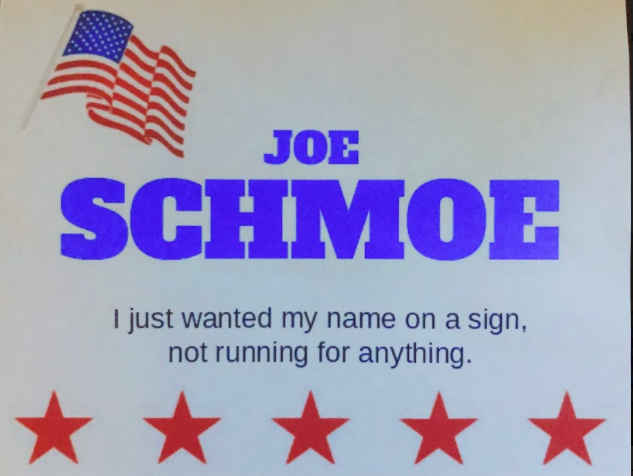

As the election creeps closer and closer, this species continues to flourish. They pop up everywhere from the side of the road to your neighbor’s front lawn and in many different varieties: political signs. While these signs are not actually springing out of the ground, they can certainly be compared to weeds. Many people find them undesirable and ugly when they congregate in thick brambles on the fences and walls that line the road. When I first noticed the return of the signs, it made me wonder how effective they really are. When people see them, does it influence their vote at all?
There’s a wide variety of opinions about political yard signs, and many disagree on how significant their impact on elections can be. A communications officer of the Massechusettes Democratic Party, Kevin Frank believes they are ineffective. In an article from The Atlantic, Kevin responded with a simple “No” when asked if he believed a political yard sign has ever changed the opinion of a voter; he cited a saying common among political operatives “Lawn signs don’t vote”. In the same article, communications director of the Massachusetts Republican Party, Tim Buckly, said that signs were actually a burden because of demands for more signs in neighborhoods and intersections. An even stronger advocate against political signs is a political consultant named Mario Piscatella. Piscatella wrote a strongly worded commentary on political signs where he stressed that they are a waste of money and that there are better ways to gain votes. Some say that political signs can help with name recognition, but Piscatella pointed out that simple name recognition without any emotional draw or narrative is useless, “You haven’t influenced a person’s propensity to vote, or altered who they may vote for should they vote”.
Of the few studies that have been conducted, there are not very decisive results. This can be attributed to how difficult it is to measure with the complex world of politics. The Washington Post wrote a piece on one of these studies by Donald Green. Green, a professor at Columbia University, released a study that suggests political signs only give a 1.7 percent point boost to a candidate, “[I]t appears that signs typically have a modest effect on advertising candidates’ vote shares — an effect that is probably greater than zero but unlikely to be large enough to alter the outcome of a contest that would otherwise be decided by more than a few percentage points.” So, signs may only be effective in extremely tight races, which can often be the case in smaller local elections.
The signs on the roads are put up by the political candidates, but signs on people’s lawns are put up by the individual property owners. Another study on yard signs by Anand Sokhey of the University of Colorado Boulder and Todd Makse of Susquehanna University in Pennsylvania tried to ascertain why individuals display yard signs, “Our findings suggest that the dissemination of yard signs is not merely a top-down process driven by campaign professionals, but a genuine participatory act … fueled by individual initiative and social networking.” They found that people are likely to put up signs in retaliation to opposing signs or encouragement from the signs of like-minded neighbors. In this study Sokhey said, “People who take time to do this kind of thing have real reasons that involve everything from letting others know where they stand, to showing pride in their candidate, to catching the eye of passing traffic.” Even if the signs may not have a large effect on elections, they can still foster a pride in civil participation that benefits communities.
I wonder if people will even notice what’s different about my sign among the healthy ecosystem of political advertisements that occupy the roadside.

 Quaranteen