Author’s Note: Follow the links throughout to go on a rabbit hole of new, enticing information about the anime world and our world! Also, I really enjoyed listening to the main theme song of Howl’s Moving Castle while writing this blog, so hopefully listening to it while reading this can set a better mood!
Hayao Miyazaki is one of the most brilliant authors, screenwriters, and filmmakers known to man. Co-founder of the famous Studio Ghibli, he has created some of the most musing and reflective animations, creating a huge timeline of our worlds- the spirit and human world. From this, the Miyazaki Theory came to be. Avoiding spoilers, the Miyazaki Theory starts with a timeline way before us and ends way after us. It starts with films that show the human and spirit world interacting, leading into films that show that spirits can be both beneficial and harmful to mankind with their motives and desires. It ends with the idea of an apocalypse and the supremacy of immortal spirits over mortal humans. Here’s a wonderful video explaining the entire theory in much more detail and depth done by ¨Zooming In On¨ on YouTube:
Skipping over the first half of the timeline, we’re starting with Ponyo. This animation tells the story of a goldfish princess who longs to become human and be on land. However, her actions flood the town with great waves that spread far and wide, the beginning of our apocalypse. We then reach Princess Mononoke and Castle in the Sky. In Princess Mononoke, a town heavily affected by the flood rebuilds their civilization from scratch by the destruction of forests, creating a tension between the spirit and human world, leading to a great war. In Castle in the Sky, another civilization greatly affected by the flood begins building their civilization up, with use of great technology that was not destroyed in the flood. This movie leads into our final animation of the Miyazaki Theory, Nausicaa of the Valley of the Wind. This film takes place during the height of the apocalypse, with their ecosystem mostly destroyed and toxic jungles. It shows the struggle to restore the human and spirit world once again.
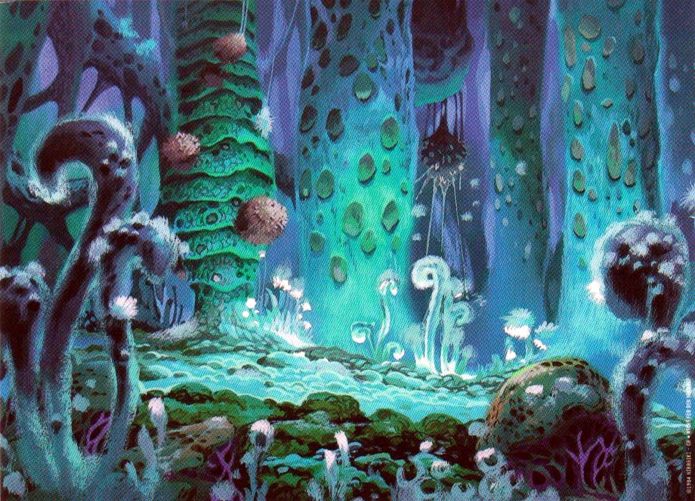
Nausicaa of the Valley of the Wind
Now besides being a completely engrossing subject and theory to look into for people of all ages, what does this have to do with anything? While this Miyazaki timeline goes through an apocalypse, doesn’t it feel as if we are too? Of course not one to the same extent, or at least for now. This catastrophic future seems so in tune with our current situation, of course with less fighting, magic, and mythical spirits. Just like the flood that had wiped the lands, leading to new beginnings as civilization had to restart, the COVID-19 virus had taken over the globe, making us start again, resetting our minds to accustom ourselves to lives at home and to wearing masks at all times. Just like how our protagonists worked their ways around their problems, we had to do the same.
On March 13th, we were flooded with sudden announcements, only believing that it would last two weeks, and by now, it seems as if a thousand years have passed. We stayed at home with no idea of our future, no glimpse into our own timeline. Everything began to blur together. Soon enough teachers began assigning work like crazy in attempts to fix our curriculum learning schedules in time, just like Ponyo’s Fujimoto who frantically did everything in his power to retrieve Ponyo from the humans before it was too late. We were bombarded by waves of assignments the minute teachers were allowed to assign work again, and by the time the waves calmed down, many students were already in a toxic jungle within their own minds and lifestyles. The beginning of our own apocalypse had begun.
Although we do have threats of global warming with rising sea levels, I’m talking about a more metaphoric apocalypse- a zombie apocalypse of lifeless souls. We generally accept zombies as reawakened corpses with non-functioning brains, and to me, I really feel as if I have become a zombie in these past few weeks. Existing in a meaningless timeline rather than truly living through everything. We go through each day aimlessly, each day the same as before. I constantly lost track of time, and the days flew by before I knew it, for even a two hour movie had more excitement in it than my life for the past ninety days. Our protagonists didn’t solve anything by taking tests and quizzes, and honestly we didn’t either. Although we couldn’t do too much because of the conditions, the same reading and questions assignments for my classes barely taught me anything during this time period.
Nothing felt new or interesting to me, and I felt as if I had a ticket for the train from Spirited Away. Although easily one of the most beautiful and serene animation scenes ever created, there is so much open meaning behind it for the viewers to comprehend. With such ethereal aesthetics to the eyes and ears, we can’t help but feel a surge of melancholy when we watch the scene. The strong sense of stillness and loneliness is seen throughout- the isolated house, the neon signs leading to nowhere, the little girl standing by herself. The entire movie from before that point was filled with chaos, excitement, and thrill, and suddenly everything stops for a couple minutes, just like how our chaotic lives suddenly came to a stop.

Click here to watch the train scene from Miyazaki’s Spirited Away
We see these lifeless souls, no faces, no emotions, no direction. They all seem to be getting off at different stops, we just don’t know what each stop means or where it leads. Right now, I am on that train. In silence, I go where my teachers take me. I do what the teachers want me to do. Why does it feel as if I didn’t have any control over my life during this time? I completed all the assignments, but what did they mean for me in my real life? This quarantine, this silence, had made me realize all of this. Where are all of these assessments taking me in life? To a good college? To happiness? To my parent’s happiness? Why do I only have questions finishing up this school year?
The train scene is the epitome of confusion and unanswered questions in a sea of silence and beauty. With just as much learned knowledge, I am getting off the train with just as many questions. I yearn for a connection that I was not able to obtain during distant learning. I loved assignments that allowed us to explore our own knowledge and understanding, not just what we could explore on a search engine. Our minds are so vast and interesting, why subject them to questions with only one right answer? I have a pile of textbooks on my desk right now, but I do not remember anything vital to my life that came from those endless pages. We barely grazed topics during this time, and I longed for a chance to go in depth about what these topics meant for me in my life.
It’s difficult to suddenly turn around the education curriculum because one girl has unanswered questions, but it was also that one little girl in Spirited Away that changed the course of the spirit world forever. Miyazaki’s films have created an open portal of thought and interpretation, making us think and reflect on our own emotional and personal development. He has inspired many artists in their own works, such as Gallant’s song ¨Miyazaki,¨ which was directly inspired by the works of our Hayao Miyazaki. I wish this openness to new ideas and concepts were more focused on in our education growing up, after all, these new ideas are what allows our society to move forward.
At the end of this blog, what did we take from it? Well, that’s up to you to decide. Let your own imagination and thought process take in everything that you read. When your mind opens up to a brand new world, that’s when you will begin to truly learn more about yourself and the world around you.
¨…it’s not a story in which the characters grow up, but a story in which they draw on something already inside them, brought out by the particular circumstances…¨ -Miyazaki on Spirited Away

 Quaranteen