This is the second in a series of articles I will be writing. These are philosophy articles, but not like the typical writings of that nature.
Two weeks ago, I introduced the new philosophy that I had created and it is named Universal Flow. In my first article, I gave a brief overview of what a Universal Flow practitioner would do in order to maintain clarity and to gain understanding. Today, I will dive into a the key tenet of Universal Flow, namely the philosophy’s ideas on change.
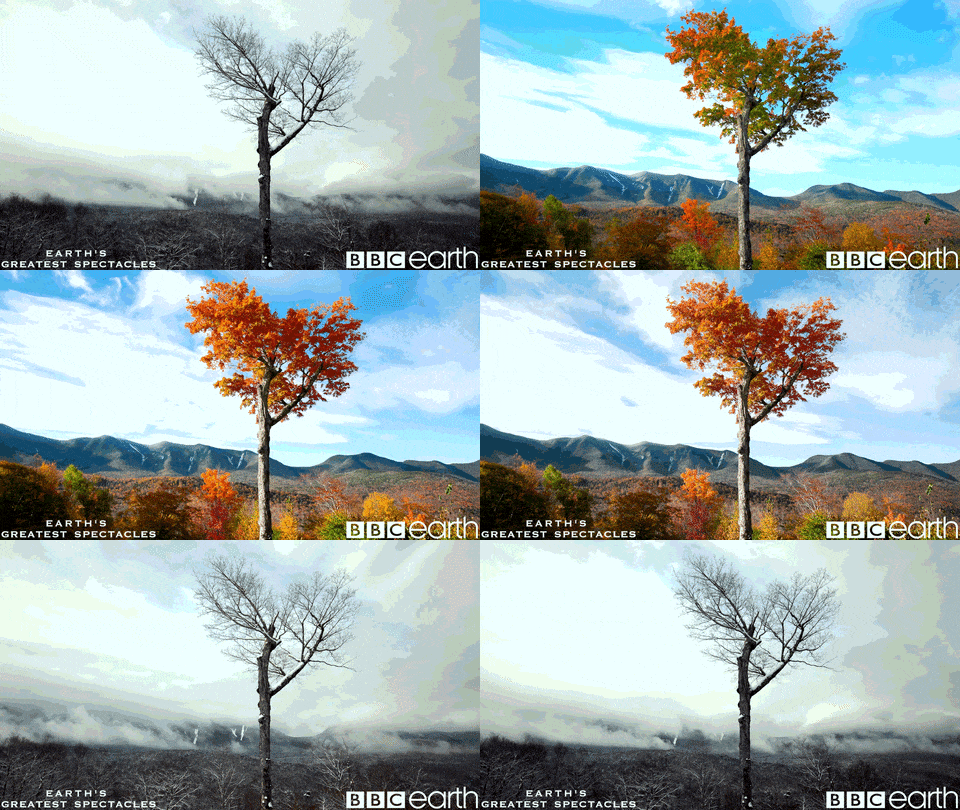
Probably the most important idea in this whole philosophy is the concept of change. Change is what drives the entire world. Day turns to night, and night turns to day. Spring becomes summer, summer becomes autumn, autumn becomes winter, and winter goes back to spring. Emotions shift by the hour. No two days are exactly the same, no two experiences are identical. Joy turns to sadness and back again. To live and thrive in this world, one must be aware of all the changes that take place. One must understand how to use them to his/her advantage, and how to endure hardship when the winds of change turn against you. What is bad will not last forever. It will be supplanted by good. Likewise, good will be supplanted by bad. Awareness and acceptance of change is the first step in attaining clarity. Accepting that the world hands out situations at random. We must enjoy all that is good, and endure all that is bad, so that we may return to good experiences.
And yet… there is evidence that some people are much happier than others. If good and bad take each other’s place, wouldn’t everyone’s life be the same? Similar events with equal amounts of joy and sadness? We know the events on Earth are influenced by two things: by nature, and by humanity. Humanity has a powerful effect on change. Humanity is able to dictate to a certain degree, what kind of change occurs. With this in mind, we have the answer to the previous questions. Some people are happier than others because they are able to master change. They endured hardship that is out of their control, and seized the opportunity to enact change in their own lives when the opportunity presented itself. It’s a matter of recognizing when the flow reveals an opening for you to exploit.
And this is why Universal Flow places such an emphasis on analyzing the past. If you know the past, take lessons from it, and study the patterns, you will be able to recognize opportunity, and choose wisely. You will be able to anticipate future events, developing a foresight that grows as you gain knowledge. Therefore, by being aware of the past, you may be able to improve your present situation, thereby preparing an excellent future for yourself. Continual learning and experience will allow you to understand more and more about this enigmatic world.
While the winds of change is often seen as unpredictable, I am certain that there is an underlying pattern that governs events. Because no two events are alike, this suggests that there may be a pattern that is consistently followed, after which variations act upon the events, giving the impression of spontaneity.

What’s important to note about change is that it prompts conflict and peace to be fluid. War follows peace and peace follows war. War is inevitable, and an end to a war phase is inevitable. Therefore, we must exercise our influence upon war, so that we must end a conflict as soon as possible, so that less people will suffer. This is precisely why a nation’s armed forces must be properly trained and maintained.
By my estimation, America is set to enter a significant period in history. What America does in the near future will dictate the flow of change for years to come. I have sensed it; I do not know when the great change will exactly come, but I am preparing myself for when it does. Before the COVID-19 epidemic, I had an inkling that the world will be set before a crossroads. There will be a major event that will determine the direction of humanity for many years to come. I just didn’t know the specifics. I predicted a large-scale conflict, but that was all I could sense. That was the limit of my ability. And still, all of that was just conjecture. None of it can be proven.
Throughout my studies, I have noticed a pattern in American history. Since the inception of the nation, there is a major conflict or trial that the nation faces about every 80 years. Since America’s victory against Britain in 1783, 78 years passed before the Civil War broke out. 76 years after the end of the Civil War, America enters the Second World War. Now, we are in the year 2020. It has been 75 years since the end of World War II, and I believe that the time for a major conflict is nearing. This prediction seemed justified when it was announced that General Qasem Soleimani was assassinated, and U.S.-Iran tensions mounted. I did not think much of these events however. It did not seem likely that war with Iran would evolve into a critical moment for America. And sure enough, things simmered down before long.
Sometime later, COVID-19 forced the world into isolation. The coming of the pandemic perplexed me. It seemed that the pattern was broken and that what I had predicted was merely the reaction to being bored. If the whole world had to face this nameless, faceless enemy, then surely the nations of the world would be working with each other in unity and in the name of global cooperation.
Here too, I am incorrect. The West is quick to blame China for the start of this pandemic, even insinuating that the virus is a part of a diabolical Chinese plot. Whether that is true or not remains to be seen. Europe turned its back on China, and China left the nations of the world to fend for themselves by cutting off exports of medical supplies. This global antagonism got me thinking. Humans have once again altered the winds of change. Perhaps now, instead of harmony, there will be acrimony. I continued to ponder with little to show for it. Then, all of a sudden, I came across an article from Foreign Affairs. It got me thinking. Perhaps, maybe I was right from the beginning. Perhaps COVID-19 is a catalyst for events to come. In the wake of all this chaos, there will be a power vacuum. And there are many who wish to fill it.
I also started comparing the COVID-19 pandemic to other major pandemics in history. And I recalled a very interesting detail. Major pandemics have lead up to pivotal conflicts and moments in history, likely due to the vast amount of death that they cause, as well as the political instability they leave behind. The major pandemics I will cite are: the Antonine Plague, the Plague of Justinian, the Black Death, and the Spanish Flu.
The Antonine Plague came about in 165 A.D and lasted up to 180 A.D, killing about 2,000 people a day. It is this time that many historians consider to be the beginning of the end for the Roman Empire. The Roman economy was drained. As one can recall, the Roman Empire eventually became split into two parts, then four, then brought together, and split up again, until finally falling to barbarian invasions.
The Plague of Justinian took place from 541 to 542 A.D. It devastated many empires at the time. Economies, especially agrarian ones were left in shambles. The Byzantine Empire was able to recover quickly, and found solutions to the problems that the plague created, while other nations still suffered. This recovery enabled the Byzantine Empire to expand its conquests and consolidate its rule, becoming a successor to the Roman Empire.
The Black Death killed around 75 million Europeans during the first wave between 1347-1351. As a result of so many people dying, there were labor shortages and high prices. Economic dislocation had a significant impact on people at the time. The Hundred Years’ War went into full swing at about this time. As a result of this war, the English and French nation-states have become consolidated, and the politics of Europe have been reinvented. As well, after the Black Death, the Renaissance was ushered in, and a truly new era began. (AP Euro textbook) The Black Death is the strongest support for the theory that pandemics drive the gears of change.
Finally, we have the Spanish Flu. This pandemic took place from 1918-1919, killing around 20-50 million people worldwide. After the pandemic ended, there was a brief respite, and following that was the Great Depression, and then, the Second World War. In the years after the pandemic, there was an economic depression, followed by years of prosperity, then sinking into the Great Depression. After the Great Depression, World War II came about as a result. The Spanish Flu serves as an example of an event following the pattern of change, but with variation.
Considering the past, it would seem as though the world would go the same way as it had in the past. Pandemic, then economic depression, then major warfare. Change has begun to act again, the culmination of human actions compounded with environmental influence has made this time ripe for chaos to tear society apart. With this in mind, I decided that I want to be a part of this major era of change. I want to be able to pick up the pieces and help rebuild society after the change has ended. I pray that people will not have to endure such chaos, but if we are to face it, then I would like to be in a position where I could be of use. I’ve decided to apply to the United States Military Academy at West Point, and have begun taking steps to get me accepted. I feel that West Point is where I can become prepared to face the challenges of the future.
I believe that I detected the direction of the winds of change. Now, I’ve made my choices, and let us see how change will affect the world, and my future. I sure hope that my predictions have no credence, and that they are just the musings of a bored child stuck in quarantine.

 Quaranteen
Well sometimes pieces start with a rest, which might be a metaphor for how change affects people at different times and can surprise you if you aren’t prepared.
Though I guess nitpicking metaphors isn’t the best thing to focus on, honestly it’s sufficient for its purpose.
Its interesting to think about how the patterns of the past might affect the future, though I’m not sure if I agree with the idea of war as inevitable. In a way, that mind set is part of what causes war. A part of what caused WWI was the acceptance of war as a normality.
I think we shouldn’t jump too quickly to violence. Maintaining peace forever may be futile, but it’s still a cause worth supporting.
LikeLiked by 1 person
Well… WWI is a prime example of incompetency during war. I did mention swift victory to alleviate suffering. It does not do to stand with a lost cause. You only waste time and energy. Sunzi (孫子) said, “The art of war is of vital importance to the state. It is a matter of life and death, a road either to safety or to ruin. Hence it is a subject of inquiry which can on no account be neglected.“. War is a part of civilization. The only thing to do is to be prepared and win swiftly.
LikeLike
Isn’t the struggle for peace a “war” with war? If that is the case maybe one day we will be prepared for peace and defeat war “swiftly.” No one really wants to die, or to kill. The first is against our biological drive and the second is against our social nature. We kill sometimes if we feel that the situation calls for it, but it should never be an easy first option. The idea of peace is a goal, just like love. Both are not results, they are a daily decision. You are not IN love, you choose to love- daily and moment by moment.
LikeLike
Yes! Absolutely. Conflict is a very part of the changes that take place in this world. We like to say that we should promote everlasting peace, but deep down we know that such an ideal is not possible. That is why our goal should be to end conflicts as soon as possible to preserve lives and resources. The key to renewing peace is to be ready for conflict when it happens, and to carry it out judiciously.
LikeLike
That’s your key to renewing peace. But it’s not THE key. Peace is a what’s called a “wicked problem.” Wicked problems don’t have a single answer otherwise they would already be solved.
LikeLike
Yes! I actually forgot about wicked problems, thank you for reminding me. At this juncture, all we can do is to delay the problem from resurfacing and wrecking havoc.
LikeLike