DISCLAIMER: This article is satire depicting what this author played during quarantine.
The recent COVID-19 pandemic outbreak has caused a fear for concern. With infections on the rise, it was decided it would be best to isolate and socially distance people to protect them from each other. Ever since the lockdown, many people have been trapped at home with no activities to partake in. However, instead of wasting time on the television watching sports, it should be used to play one. Not only does it take practice and skill, but it requires knowledge of what happens around you to understand the best way to receive a football using one hand.
On the night of November 23rd, 2014, O’Dell Beckham Jr. left his mark on the football field with an impressive stunt. The Giants’ wide receiver sprinted into action and made his first and famous one-handed catch that inspired others to do attempt the same.
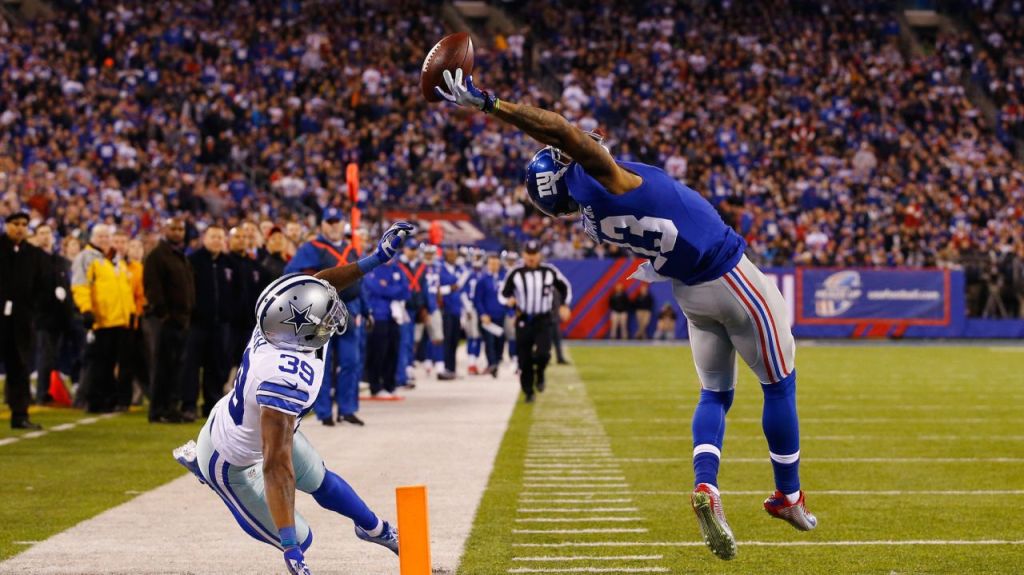
The difficulty of this technique can vary on a large scale, depending on the skill of the player. This article will guide you through the steps and movements required to achieve this famous “O’Dell Catch of the Year.”
On average, a quarterback will throw a football at the speed of at least 45 miles per second (mph). While the ball is airborne, a receiver’s quick decision will determine the success of the one-handed catch. The average person’s reaction time is 0.25 seconds; on that night, O’Dell’s opportunity to catch that Hail Mary throw from Eli Manning was 0.16 seconds for him to react and position himself to receive the ball. 0.15 seconds is the normal amount of the time for a football to complete a full spiraling-spin cycle. O’Dell had to jump 4/10th of a second in order to situate himself to effectively catch the ball.
For the normal person, O’Dell’s expertise in his catches and training allowed him to successfully complete the feat. While many fear that this is impossible to achieve, in reality, with practice and consistent training, this guide will help lay the stepping stones to a well-renowned ability.
To warm-up, the player should practice catching the ball from a short distance, preferably around 15-20 feet. Start in a sprinting posture with your arms and body relaxed, keeping low to the ground. When the quarterback signals to move, begin moving at a pace of 4 feet per second, hitting the floor with the toes to concentrate a strong amount of force to push the body forward. Since this is the warm-up, pace yourself to run accordingly, keeping at around the rate of 1-3 mph. Proceed to the other side of the field, keeping your perspective at the straight at the field for approximately two to five seconds, depending on the route in which you take. Once you are ready, turn your head back to face the quarterback, signaling that you are ready to receive the throw.
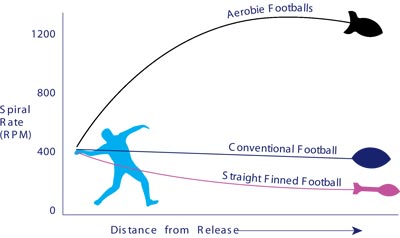
The spiraling rate of a conventional football is about 600 rotations per minute when thrown by a professional quarterback.
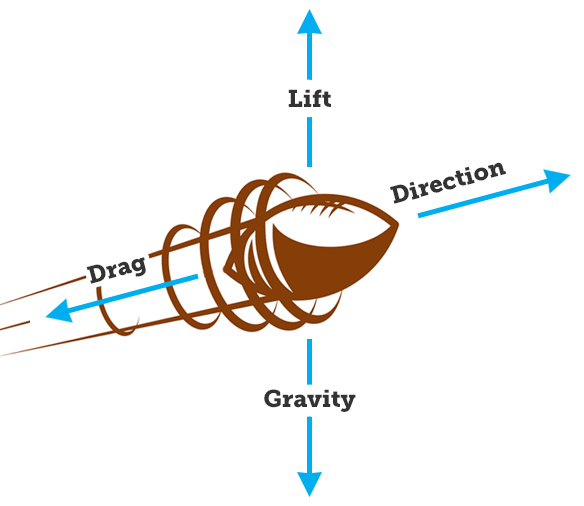
The spinning movement when spiraling the football allows it withstand the forces acting upon it so that it is able to travel a farther distance. The method of which the ball is ejected can determine if it successfully progresses straight or encounters too much air resistance, causing it to wobble. Not only is the way the ball is thrown affects how it travels, but the weather in the immediate vicinity is also a major factor. Using Gay-Lussac’s Law, it is known that pressure is directly proportional to the temperature. In warmer weather, the increased temperature will cause the pressure in the ball to increase, which would make it slightly over-inflate.
Now that you know the basic physics of an airborne football, it is time to proceed to the next phase, catching. As you dash towards the field, pay attention to the trajectory of the projectile. Pace yourself according to the pathway of the ball in order to catch it in the desired position.
When catching with one hand, pay attention to the end tip of the football, using the largest amount of your palm to increase surface area, therefore grabbing the entire football with a single hand. Extend the forearm to the farthest length without locking the elbow. Ensure that the hand is dry to increase friction when the football slides across your fingers. Once the ball has reached the target, continue moving until the object is in tight possession in order to not fumble it. Standing still will increase the chances that the ball will spiral out of your grip as it lands.
Hopefully, this article has elaborated the technique and science behind the football one-handed catch that will allow you to undertake this maneuver yourself. Instead of feeling sorrowful while trapped inside during quarantine, you can practice this new skill and impress a crowd once isolation ends. Playing a sport is more fun than being stuck on a chair all day; I would know.

 Quaranteen